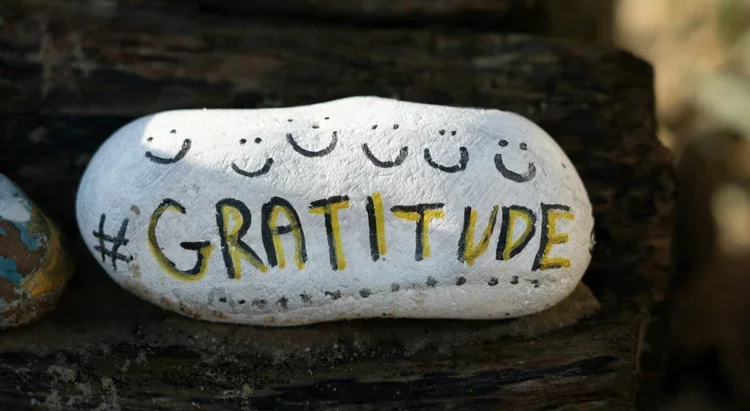
How can we show gratitude?
Src: Nick Fewings Unsplash
My husband and I linger in our Midtown hotel lobby in New York City. We’re waiting for our airport pickup to catch a delayed flight back home after a birthday surprise, fun-filled week, grateful for a delay versus cancellation.
There’s a large glittery sign winking down on us — “Say Something.” Not like the “see something, say something” signs you see on the subway, more of a random acts of kindness message.
We had dinner last night with friends from our college years at UW-Madison. While we’re waiting in the lobby, emails fly back and forth about how great it was catching up in person as we pushed replay on our memories and everyone conjured personal images in their mind’s eye.
Like — dancing to The Cars on pulsating floorboards at a local club, or the thousands of birthday and wedding chocolate chip cookies I baked over the years. Everyone kept trying to remember what year a specific memory was, knowing that only digging into old photos with dates could confirm.
What does gratitude feel like? How can we let people know the impact they had on our lives while they are still alive and not just words said at their funeral?
what does gratitude feel like?
Gratitude to me feels like it’s nestled in warmth. I feel it when I hear my granddaughter say, “BB and Papa,” in her sweet, breathy voice. It’s as if the words hold magic and should best be used carefully, in little bits because of their power. I am grateful for these little granddaughter legacies marching into the future of their lives, watching from a distance as they learn to navigate this complicated world. Reminders of hopefulness.
Back in New York waiting for our 9/11 Memorial & Museum tour guide outside, we shivered in the polar vortex air. A blue sky overhead belied the sobering heaviness of the place where the World Trade Center twin towers stood for decades. The depth of the two reflecting pool’s massive holes with water cascading over the edges. One single white rose placed on a name, a ritual carried out for every one of the thousands of victims on their birthdays.
Inside the museum, there were twisted steel girders from the trident columns, all mangled metal from the blast. Beautiful and horrifying at the same time. Seeing the slurry wall holding back the Hudson River, all water-stained. But standing firm in a defiant “I’ve got you covered” protective sentry way whose shift ended almost 25 years ago — yet it hasn’t really. So many artifacts.
My husband and I remembered having drinks ages ago in one of the towers when we saw the retrieved sign from The Windows on the World restaurant, virtuality intact. Hard not to imagine … what if? How can you hold sorrow and gratitude at the same time?
In Practicing Gratitude in a Fragmented World, Debra Kawahara, Ph.D. shares, “Gratitude is not a denial of hardship. It is a deliberate act of resilience, a refusal to let despair dictate the terms of our lives. To practice gratitude is to exercise quiet courage … to recognize that even in difficulty, meaning persists. In this way, gratitude is not passive. It is a form of resistance against hopelessness.”
how can we let people know their impact while still alive?
A couple of months ago, out of the blue, a friend emailed. He was attending a funeral of someone near our age and listening to other college friends speak about the impact of the person who had died. He wondered what we would say about each other at our respective funerals.
My husband commented, “Wouldn’t it be nice if we wrote things to people who meant something to us before they died, rather than spending all the time on obits after they’re gone?”
In this month’s Thought Echoes Podcast, Hiroko Yoda, author of 8 Million Ways to Happiness, found herself in the depths of a deep black void after her mother died. Once she found her way out after lots of reflection, time in nature, and focusing on gratitude especially with her mother. Hiroko wanted to help people looking for meaning in the modern world but not wanting to lock themselves into any specific faith. She wanted to share her Japanese culture with the rest of the world.
Hiroko encourages us to focus on gratitude and shares the limitless ways we can show it every day, including before someone dies.
“I thought I was absolutely alone, but then I realized I wasn’t. When I opened my eyes, opened my heart, I realized that I was surrounded by a lot of lives.”
In this world, some days it's tough to shift attention away from all that is wrong in the world. But by adopting an attitude of gratitude, we can touch a deeper thread of meaning in our lives and notice beauty in the chaos, as a form of resilience.
***
Right before the trip to New York, I scanned 35mm slides from the early 1980s for a photo project. I also found slides of the friends we visited. Those rare kinds of friends you can drop back into the last time you saw them as if no time has passed. Most of the slides were very, very dark, yet it was so fun to see our younger selves — before marriage, before kids. So full of potential with no idea of the twists and turns our lives would take.
In the back-and-forth emails with our New York friends, my husband shared what a big influence one of them was at the start of his career, and among a handful of people that helped guide his life’s trajectory, and for that he will always be grateful. I couldn’t help but reflect on people who influenced me in my lifetime and ask myself? But have you told them?
Who are you grateful for? And like the winking sign at our Midtown hotel encouraged, maybe it’s time to “Say, Something.”
If this reflection resonated, I’d love to hear your thoughts below.
And if you’d like to continue exploring the nature of our thoughts, you can subscribe to my newsletter Thought Echoes➚